

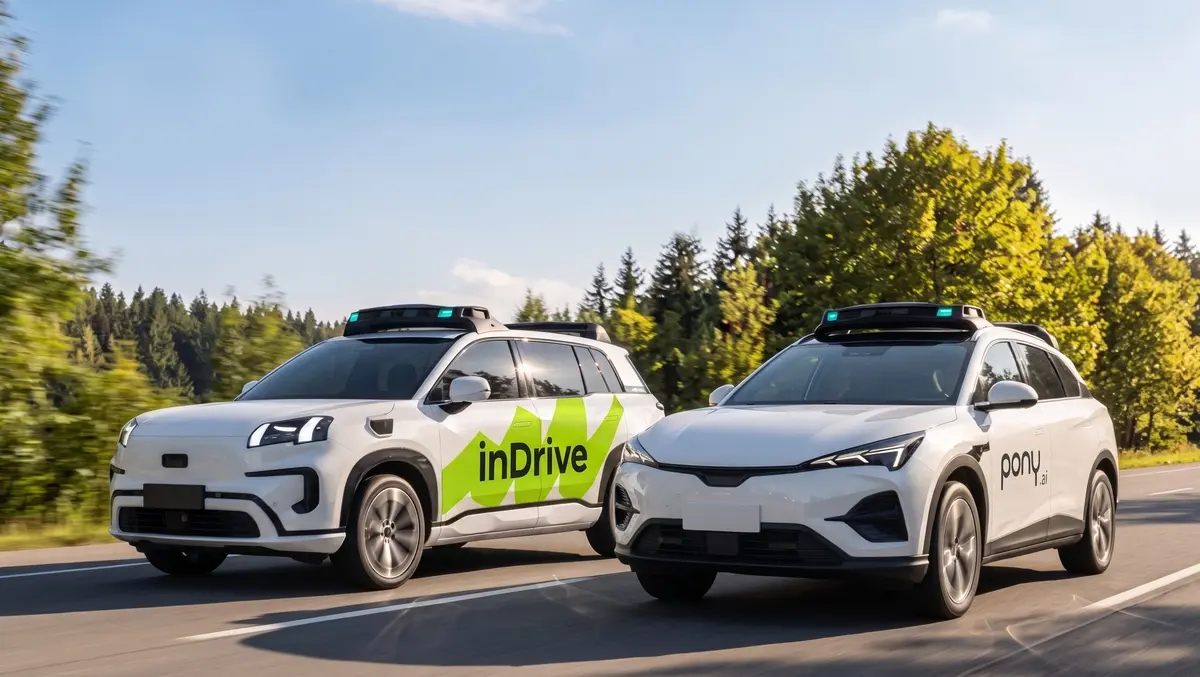

inDrive has signed a memorandum of understanding with NVIDIA and Pony.ai to explore autonomous ride-hailing in Kazakhstan, which would be the first test market for the collaboration.
The companies plan to assess the technical, operational, regulatory and commercial feasibility of offering Level 4-ready autonomous vehicles through the inDrive app. Pony.ai would supply its seventh-generation robotaxis, inDrive would run the service on its platform, and NVIDIA would provide the AI infrastructure.
Astana is the intended launch city, subject to agreement with the Kazakh government. The capital, with a population of about 1.7 million, has been identified as a suitable urban market for testing robotaxi services alongside existing transport options.
Kazakhstan was selected after introducing what the companies described as its first structured legal framework for driverless transport. The move forms part of a broader national push on digitalisation and artificial intelligence, creating a regulatory setting for an early market test in Central Asia.
The proposed service would use Pony.ai's Gen-7 robotaxis, which are described as Level 4-ready and include multi-sensor fusion, system-level redundancy and fail-operational design for driverless operations.
NVIDIA's role centres on its Hyperion platform and Halos safety system. Hyperion is a reference sensor and compute platform for Level 4 autonomous vehicles and robotaxis, while Halos is the company's full-stack safety system for autonomous driving.
The arrangement gives inDrive a way to test autonomous vehicles in one of its existing markets. Its app has been downloaded more than 400 million times, and it operates in more than 1,200 cities across 47 countries, offering ride-hailing as well as intercity transport, delivery and financial services.
Pony.ai has already run fully driverless commercial operations in major Chinese cities, according to the companies, and has also deployed its technology in Europe, the Middle East and Asia. That experience is expected to inform the Kazakhstan project as the parties examine how the service would work under local road, weather and regulatory conditions.
Astana's climate was another factor in its selection. The city's long winters, snow and ice could test autonomous driving systems beyond the milder conditions often associated with early deployments.
"Autonomous mobility has the potential to make transportation more affordable and accessible in the cities we serve. Partnering with NVIDIA and Pony.ai, we want to understand, carefully and responsibly, how this technology could fit Kazakhstan's roads and communities - and what it could mean for riders and drivers across our markets. Kazakhstan's forward-looking approach to regulating autonomous vehicles creates the environment to do that, and that could serve as a model for other markets. In addition, Astana is also the second-coldest capital in the world, with long winters, snow and ice. Launching here will provide an important opportunity to evaluate autonomous driving technology in challenging winter conditions. Success in Astana could offer valuable insights for expanding autonomous mobility to other locations facing similar challenges," said Arsen Tomsky, Founder and Chief Executive Officer of inDrive.
The Astana project could become the basis for a broader regional assessment. After an initial launch, the companies plan to evaluate whether the same model could be used in other cities in Kazakhstan and in other countries where inDrive operates.
That will depend on the outcome of the first phase, including regulators' response and whether the technology can be integrated into local transport networks. The commercial case will also matter, particularly in ride-hailing markets where cost, safety oversight and public acceptance are likely to shape rollout decisions.
"Kazakhstan represents an exciting opportunity to bring autonomous mobility to a new market in Central Asia," said Dr. James Peng, Founder and Chief Executive Officer of Pony.ai. "Drawing on our experience in scaling fully driverless robotaxi operations in China and expanding into international markets, we look forward to working with inDrive and NVIDIA to explore how our proven technology can be adapted to local needs. This collaboration marks another step toward our vision of making autonomous mobility accessible to more people around the world."
For NVIDIA, the project adds another transport deployment built around its autonomous vehicle platform. "Bringing autonomous mobility to more communities requires AI built for the complexity of real-world driving, with safety at its foundation," said Rishi Dhall, Vice President of Automotive at NVIDIA. "With NVIDIA Hyperion and the NVIDIA Halos safety system, inDrive and Pony.ai can explore a path to scalable robotaxi services in Kazakhstan, combining autonomous driving technology with a platform that connects millions of riders."