


IoT gateway hardware revenue to hit USD $2.89bn by 2030
Tue, 24th Nov 2026 (Today)
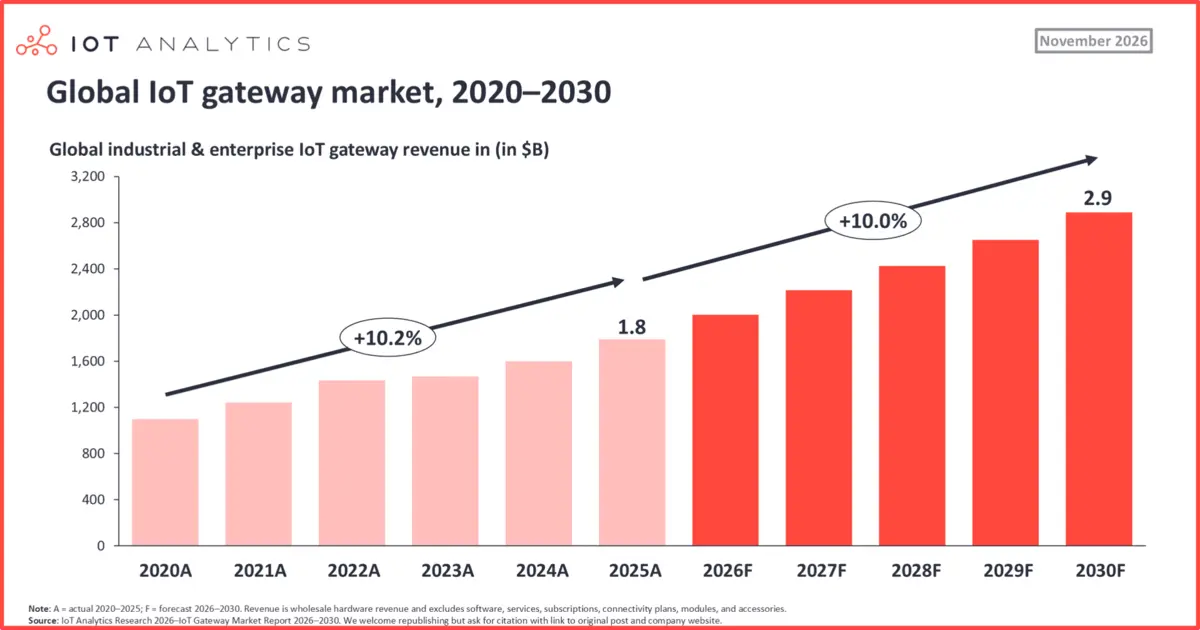
Global industrial and enterprise IoT gateway hardware revenue is projected to reach USD $2.89 billion by 2030, according to IoT Analytics. The research group estimates the market generated USD $1.79 billion in revenue in 2025.
That forecast implies annual growth of 10.0%, with the market reaching an estimated USD $2.0 billion in 2026. The study cites demand from industrial operators linking older operational technology equipment to IT systems, utilities adding gateways at distributed energy storage sites, and network upgrades involving 5G and Wi-Fi 7.
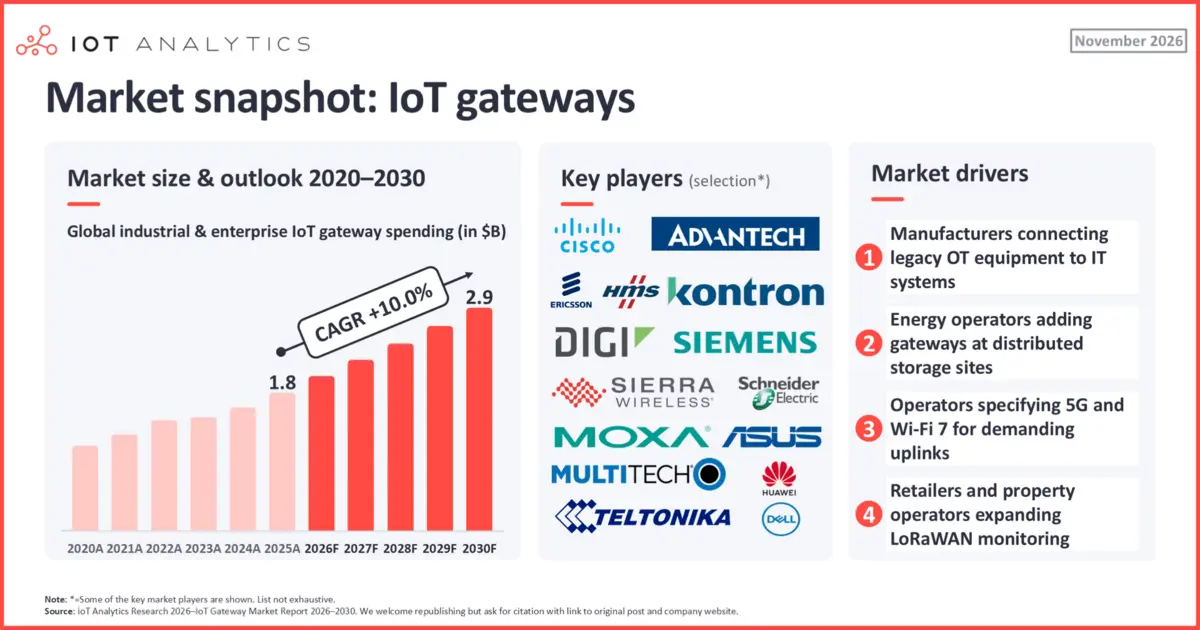
IoT gateways sit between field devices and higher-level systems, connecting equipment such as meters and programmable logic controllers to monitoring and management platforms. The analysis suggests spending on gateway hardware is driven less by the total number of connected devices than by the number of sites, network segments, coverage gaps, and requirements for reliability or capacity.
Industrial users are expected to account for most of the additional revenue over the forecast period. IoT Analytics projects industrial companies will contribute 60.6% of incremental revenue between 2025 and 2030 and hold 62.4% of total market revenue by the end of that period.
Enterprise users, by contrast, are forecast to generate more unit shipments than industrial buyers but less revenue growth. The report estimates enterprises will account for 57.9% of additional shipments but only 39.4% of incremental revenue, reflecting lower average selling prices than industrial gateways.
Industrial demand
One of the main reasons for the industrial share is the continued use of installed equipment in factories and process industries. Rather than replacing functioning hardware, companies are connecting existing operational technology assets to enterprise systems, creating demand for gateway devices that bridge legacy and modern environments.
This is particularly relevant in brownfield settings, where operators want to digitise existing facilities without large-scale equipment replacement. In these cases, gateways relay data from older equipment into newer software environments for monitoring, analysis, and control.
The utilities segment is also expected to add revenue as energy systems become more distributed. IoT Analytics estimates about USD $236 million in additional utilities gateway revenue between 2025 and 2030, with storage installations adding new integration points where gateway hardware may be deployed.
Connectivity shift
The study also highlights a shift in the connectivity technologies used in gateway shipments. Among cellular gateways, 5G is projected to rise from 6.9% of shipments in 2025 to 42.7% in 2030.
For Wi-Fi gateways, Wi-Fi 7 is expected to grow from 3.4% of shipments to 33.8% over the same period. The analysis says these technologies are being specified for higher-bandwidth links, managed connections at critical sites, and locations where local wireless networks face congestion.
LoRaWAN is forecast to play a different role in the market. Retailers and property operators expanding remote monitoring are expected to increase LoRaWAN gateway volumes. The technology is projected to account for 11.2% of additional gateway shipments between 2025 and 2030, but only 4.2% of incremental revenue because of lower average selling prices.
Blurring lines
The research also points to changes in the role of some gateway devices as vendors combine connectivity with more local computing features. That could change how buyers distinguish between gateways and edge computing systems in some deployments.
"IoT gateways have traditionally connected field equipment to higher-level systems. However, some gateway-class devices now combine connectivity with local computing and AI capabilities. Additionally, support for containerized applications allows compatible gateways to run multiple workloads on shared hardware. In our view, this could reduce the need for separate gateways and edge computers in selected installations, while increasing the computing capabilities required from individual devices. That said, dedicated gateways are likely to remain relevant for cost-sensitive monitoring and applications requiring isolation or deterministic control. This convergence could also make the distinction between IoT gateways and industrial PCs less clear," said Satyajit Sinha, Senior Principal Analyst at IoT Analytics.