


How data centres make the FIFA World Cup possible
Thu, 11th Jun 2026
Major sporting events bring people together across borders and cultures, and the FIFA World Cup is perhaps the biggest of them all.
Roughly 1.5 billion global fans tuned into the final match of the 2022 tournament, and FIFA estimates about 5 billion people engaged with content across all platforms and devices.
The 2026 World Cup is set to be even bigger with teams from 48 nations instead of 32. That means more matches in more venues, and more fans taking a direct interest in the action.
For the broadcasters, it raises some difficult questions: What does it take to bring all the matches to so many viewers with a consistent experience across all time zones? How do you scale up to ingest, edit and distribute content from so many matches in different cities; and how do you do cost-effectively and without building permanent infrastructure no longer needed when the tournament ends?
The answer to these questions is data centres and network infrastructure. Just like every other aspect of our daily digital lives, data centres provide the foundation that makes streaming content possible. When you gather with friends and family to watch a match and feel that moment of transcendent joy when the ball hits the back of the net, data centres helped make that happen.
Inside the content life cycle for streaming sports
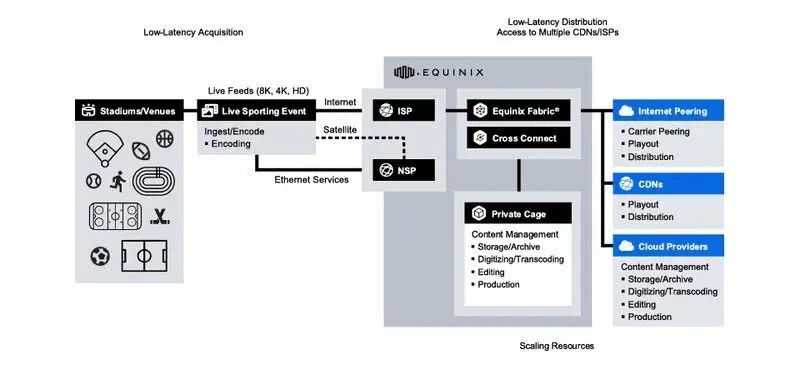
The first step in the streaming sports lifecycle is to capture footage from the matches. These live feeds take advantage of high-resolution formats such as 8K to give viewers the same clarity as if they were in the stadium. This is great for viewers, but it's a challenge for broadcasters because the feeds are so large that they need scalable network infrastructure to instantly move the footage.
Broadcasters use a combination of public internet connectivity and ethernet services to rapidly move the footage from the stadium to the content production facility, working with an ecosystem of different internet service providers (ISPs) and network service providers (NSPs) to get the connectivity needed.
Inside the content production facility, broadcasters perform a range of tasks from storing the content locally, digitising, transcoding, editing and preparing it for distribution, before transmitting the content to the content provider and distributing the content to viewers.
The reason that major sporting events like the World Cup feel like such a communal global experience is because we all get to watch the action in near-real time. Compare this with other digital experiences like streaming a new album. The moment the album drops it creates a massive spike in traffic, but fans continue to stream the album as time goes on. With sports, experiencing the live event while everyone in your social media feed is posting about it, is the entire point.
Streaming live sports is possible because broadcasters have figured out how to minimise latency across every step of the content lifecycle, from acquisition to management to delivery. And the only reason they're able to achieve that is because they choose the right infrastructure strategy and the right ecosystem partners.
Choosing the right digital infrastructure for sports streaming
When it comes to content management infrastructure, broadcasters have options. They can either deploy inside a private cage in a colocation data centre or in a cloud environment. Both options provide the flexibility needed to scale up resources in a cost-effective manner before a big event like the World Cup and then scale back down afterwards.
But the question is not "colocation or cloud?" – most broadcasters are using a hybrid infrastructure model to get the best of both worlds.
For instance, broadcasters can leave their high-quality video assets in a colocation storage environment that they maintain complete control over. They can use cloud storage for low-res proxy versions, which are much smaller and quicker to move for agile post-production workloads. After they process content in the cloud, they can send lightweight JSON instruction files back to the private infrastructure environment. Then, they can apply the same changes made in the cloud to the original high-quality video assets. Since the larger video files don't have to move from colocation to cloud and back, broadcasters can maintain control over those files locally and keep data egress costs low.
Who makes up the digital media ecosystem?
To handle an event the size of the World Cup, broadcasters can't do it alone. They need help from a variety of ecosystem partners:
- NSPs and ISPs provide low-latency connectivity, enabling rapid transfer of raw footage from venues to production teams and fast distribution of edited content.
- Cloud providers deliver scalable infrastructure that supports agile editing and production workflows wherever broadcasters operate.
- Content providers manage the final stage of distribution through broadcast streaming platforms and social media channels. For example, FIFA has announced partnerships with TikTok and YouTube for the 2026 World Cup.
- Content delivery networks and internet peering help ensure fast, reliable streaming and a high-quality viewer experience.
- Broadcast security providers protect content throughout their lifecycle, including anti-piracy measures that safeguard broadcasters' investments.
Since broadcasters need to work with so many partners, it's important to deploy in the locations where they are already gathering, which is in an Equinix colocation data centre. They are already home to thousands of these partners where customers can simply create direct, private connections using Equinix Fabric, our virtual interconnection solution.
How does data sovereignty impact sports streaming?
The World Cup draws viewers from every corner of the world and this year's tournament will be the first hosted across three different countries. With matches across the U.S., Canada and Mexico, and those same matches being watched across the planet, it adds up to a lot of digital traffic crossing international borders.
This makes the World Cup challenging from a data sovereignty perspective: broadcasters must figure out how to distribute their traffic to global viewers, without running afoul of local requirements in any specific jurisdiction.
Data sovereignty is simply a matter of control. Broadcasters need control over where their data is archived and processed. Private infrastructure offers full control over physical hardware and placement. In contrast, public cloud abstracts the underlying physical infrastructure, thus offering less control over data processing and location.
Broadcasters also need control over where their data moves, which can be more challenging. It requires intelligent networking solutions to ensure that data traffic doesn't just follow the quickest, most direct route from point to point. It needs to follow the best route, accounting for both performance and compliance requirements.
Equinix Fabric Geo Zones is a new sovereignty enforcement layer of Equinix Fabric. Customers can design connections that respect boundaries and comply with digital sovereignty requirements in Australia, Brazil, Canada, Japan, Switzerland, the U.K. and the U.S. A new EU zone is coming soon.
May the best team win.